
"He who must not be named"
No, the other dark wizard.

September 13, 2025 ~ Vol. 41
This week two of our local public radio stations, North Country Public Radio (NCPR) and WAMC with headquarters in Albany joined forces to air a simulcast presentation on the north country’s state of affairs, with a focus on our relationship with our Canadian neighbors. The event was held before a live audience at the High Peaks Resort in Lake Placid.
Three panels of speakers each had the stage for an hour, moderated by WAMC Roundtable host, Joe Donahue, and long-time WAMC North Country Bureau Chief, Pat Bradley. They were joined by NCPR’s Assistant News Director and Adirondack reporter, Emily Russel, and NCPR Champlain Valley reporter, Cara Chapman.
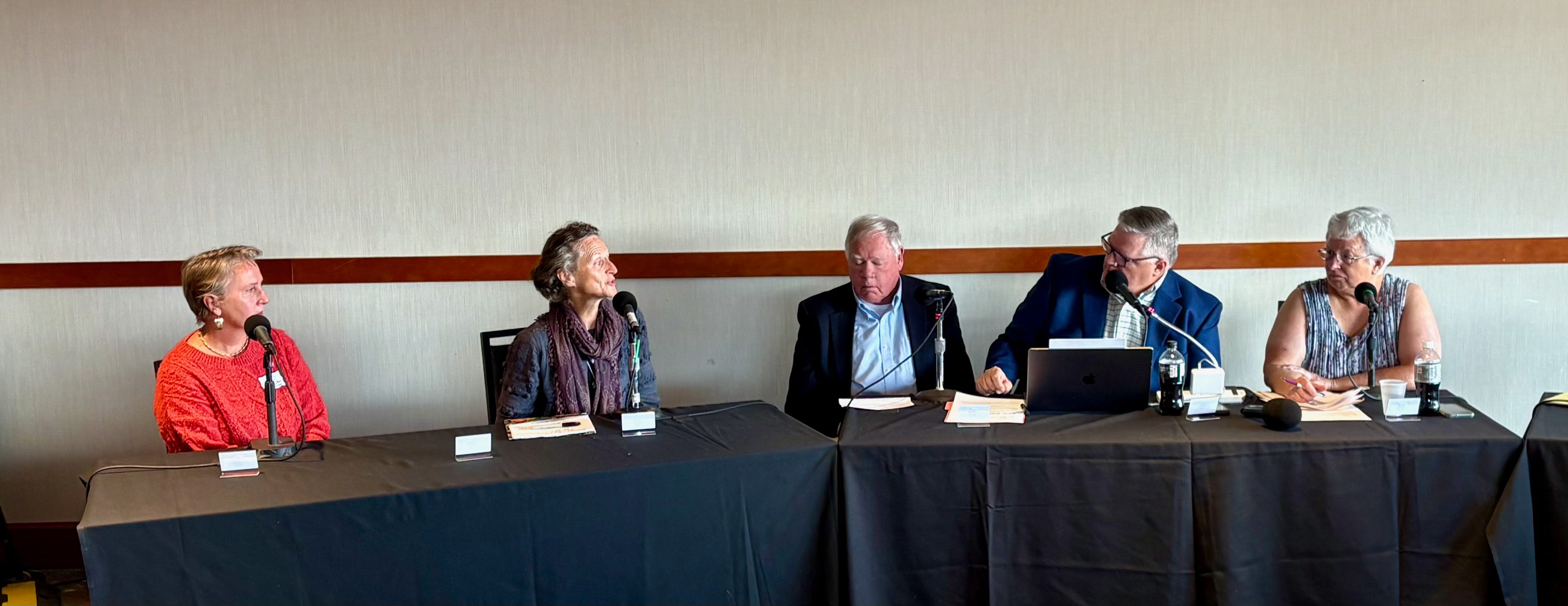
Pictured: Nathalie Thill, ADK Center for Writing, Martha Swan, John Brown Lives! / Gary Smith, ADK Film Board / Joe Donahue & Pat Bradley, WAMC.
A dozen speakers addressed the issues faced by north country communities, many of which predate the current Canadian trade policy induced antagonism. Rural north country communities have long suffered from declining populations and the conditions precipitated by it such as declining student enrollments. That lack of scale in the student population makes it difficult to operate a school district (or a fire district, or provide sufficient EMT coverage). Dale Breault, BOCES Superintendent for Franklin, Essex and Hamilton Counties was one of the panel participants.
The Saranac Lake School District, which Breault works in, covers all or part of each of those three counties. The quandary in this story is that the district’s three counties send only one thousand students to the four schools in the district, which spans a footprint of over six hundred forty square miles. The size of the district is immense, but consolidating school systems is really not an option in most Adirondack communities because students are already traveling on a bus far longer than is advisable to get to school. Consolidating with a neighboring community to save money would only make that problem worse. Many schools have, however, consolidated sports teams as some schools are unable to field a team with just local students. Our Schroon Lake Central School teams have traveled the eighty-four miles (one way!) to Chazy, near the Canadian border, for matches.
Budgetary shortfalls caused by the announced cutbacks in federal aid to New York State will filter down to the local districts next fiscal year. Rural districts, such as those in the Adirondacks, will be the hardest hit and are bracing for the impact if the state does not step in to cover the $463 million in federal aid that was eliminated by the Trump administration. We are about to go from really bad to much worse.
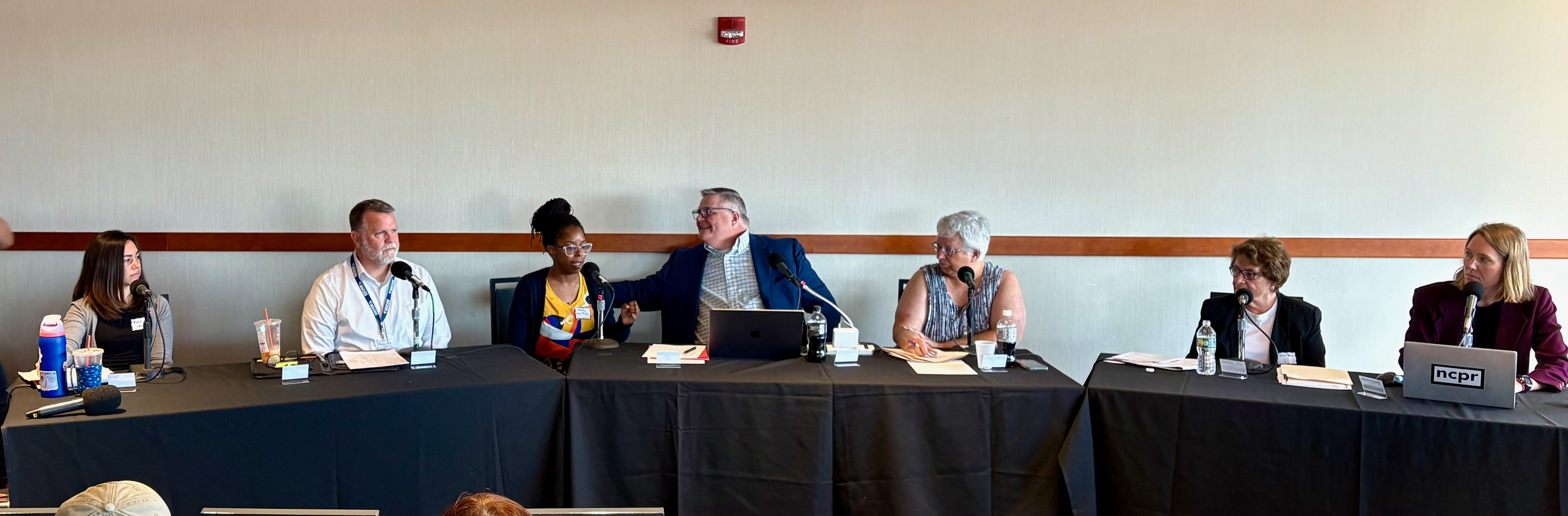
Pictured: Katie Long, North Country Development / Dale Breault, BOCES / Tiffany Rea-Fisher, ADK Diversity Initiative / Joe Donahue & Pat Bradley, WAMC / Donna Beal, Mercy Care of the ADKS / Emily Russell, NCPR
Two more long time nonprofit leaders spoke about the plight of the not-for-profit community as traditional grant funding is impacted by cutbacks in federal government support. At the same time that the federal government is reducing or eliminating support for the arts and humanities, other private foundation support is being diverted to help the urgent requests for help from nonprofits focusing on the “social safety net” that assists our most vulnerable neighbors with basic needs like food and shelter. In the pecking order of who gets funded first, “hungry always wins”, which means that non-profit directors like John Brown Lives!’ Martha Swan must scramble for support, and also seek collaborative opportunities to cut administrative and programming costs. Nathalie Thill from the Adirondack Center for Writing used examples of ACW’s recent collaborative programming with the Sembrach in Lake George, and also her organization’s “Howl – Story Slam” events—impromptu story telling standup staged in cooperation with NCPR at venues all around the north country. Both organizations share the stage, and the expenses.
The Adirondacks have long suffered from a lack of diversity in its population. Two organizations that attempt to address that issue in their mission are the Adirondack Diversity Initiative and John Brown Lives!, the “Friends Group’ supporting The John Brown Farm State Historic Site in Lake Placid that Martha Swan founded some twenty-five years ago. Ms. Swan is retired from teaching but not educating, and her organization has expanded its programming, and its portfolio, far beyond its abolitionist roots to become a nationally recognized human rights center.
Tiffany Rea-Fisher, The Executive Director of the Adirondack Diversity Initiative, was also a presenter at the conference. ADI was founded ten years ago by a group of community leaders who believed that the region needed to embrace two core beliefs that in essence became the ADI mission statement:
“The Adirondack region should be welcoming to and inclusive of everyone.”
“The Adirondack region should be relevant to and supported by an increasingly diverse New York State and American population.”
There was nothing in those words that anyone found particularly political or confrontational when the organization was founded ten years ago, but here we are. DEI programs are being attacked, defunded, and dismantled across the country. At one point in her presentation, Ms. Rea-Fisher observed that “our diversity is our strength.” She was preaching to the choir, as I am sure that the live audience attending the conference reflected the makeup of the public radio listeners that support NCPR and WAMC. The people who needed to be reminded of the benefits of a diverse community, or organization, or workforce were no doubt not listening in.
As we approached the halfway point in the three hour broadcast, it occurred to me that none of the participants that had spoken so far had addressed the elephant in the room. We had talked about things like cancelling DEI programs, and defunding education, and defunding the arts and humanities, and no one had mentioned the name of the one person responsible for all of it. It was as if the President was Lord Voldemort, the Harry Potter dark wizard, “He who must not be named”. As the next hour of panelists took the stage, for a discussion of our trade war with Canada, I wondered if the speakers would be able to get through the hour without acknowledging the cause of everyone’s problems.
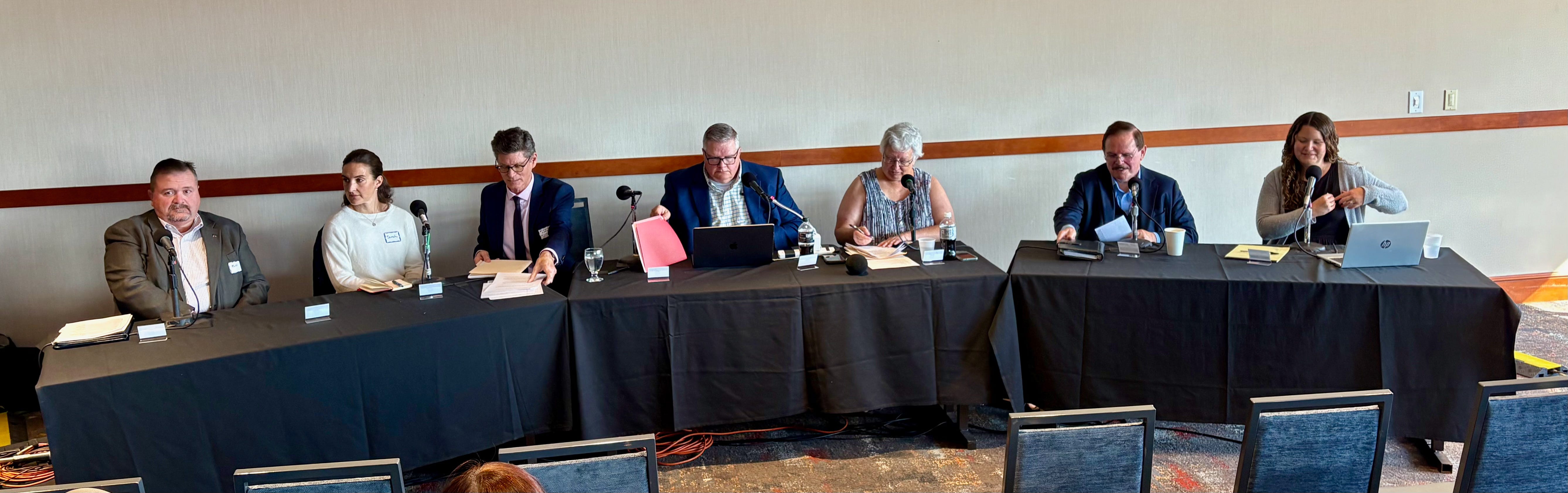
Pictured: Matthew Parrott, A.N. Derringer / Sarah Galvin, Bookstore Plus / Neil Forkey, St Lawrence University / Joe Donahue and Pat Bradley, WAMC / Gary Douglas, North Country Chamber / Cara Chapman, NCPR
WAMC’s Pat Bradley kicked off the discussion with an observation. Tourism and cross border business used to be an annual story with the obligatory once a year coverage in search of something interesting. Not today. The impact of the trade war with Canada on our communities and the communities of our Canadian neighbors has been dramatic, and significant.
The panelists spoke about how this tariff / trade / regulatory story has blossomed into a much larger story of consumer-sentiment blowback, resulting in what is effectively a boycott of US products and services by many Canadian consumers.
One of the speakers was Associate Professor Neil S. Forkey, the Chair of Canadian Studies at St. Lawrence University (which owns NCPR). Professor Forkey has dual citizenship with Canada and the U.S and lives in Montreal. His comments about the state of our relationship with Canada focused on more than the numbers. Canadians’ “elbows are up”, he shared, surprising no one in the room. They are “mystified”, and “offended”, but most importantly, they “feel betrayed”. You may recall that the impetus and the White House’s stated reason for imposing these new tariffs on Canada was that our trade agreement with Canada was allegedly a “national security threat”. The legitimacy and the legality of playing the “national security” card is working its way through the courts, but that accusation did not sit well with Canadians—at all.
Geography has made us neighbors. History has made us friends. Economics has made us partners. And necessity has made us allies. Those whom nature hath so joined together, let no man put asunder.
From President John F. Kennedy’s address to the Canadian Parliament. May, 1961
Canadians have shifted their purchasing habits and are avoiding doing business with US companies or buying US products. Some provinces have removed US liquor products from all provincial distribution centers. An August poll by Royal Lepage suggested that over half (54%) of Canadian “snowbird” homeowners in Florida and Arizona intend to sell their homes within a year and reinvest in Canada. Most respondents cited the current political climate and administration as the reasons for leaving.
The tourism industry has been particularly hard hit, as Canadian vacationers look elsewhere to spend their leisure time, and their dollars. That part of this story has had an outsized impact in the north country of upstate New York. Tourism is often the dominant economic driver in many Adirondack communities, including my hometown of Schroon Lake, just ninety miles south of the Champlain border crossing. The panelists all implored the audience to do what they could to help repair the damage, including traveling to Canada—something that we plan on doing later this month.
The current economic numbers are startling, but the numbers do not necessarily reflect the total impact to our local economies or carry any insight into how long the current imbroglio will last. Gary Douglas, the CEO of the North Country Chamber of Commerce has been involved in cross-border politics and trade for as long as I can remember. He was a panelist at the event. Gary confirmed Professor Forkey’s observations about the breakdown in the relationship with our Canadian neighbors, and how that break in relations, that breach of trust, is not going to be reparable anytime soon. He spoke to the audience about the deep, long-term relationships that northern New York and Canada have enjoyed, both business and personal. He reminded the audience that Canadians have fought— voluntarily—alongside US troops going back to the Civil War, when thousands of Canadians joined the United Army to fight against the Confederacy. They feel betrayed, and that is not something you can fix with the next trade deal. Canada and Canadian Prime Minister Mark Carney are looking for new – reliable – trading partners and they are looking towards Europe. Douglas also made a point of the difference between the impact of placing these new tariffs on Canadian exports, and the impact on Canadian trade caused by the Covid pandemic. Both circumstances brought about a cataclysmic reduction in cross-border traffic. Two thirds of the Canadian economy depends upon trade with the United States, so they are intimately familiar with dealing with impacts of this magnitude. But this is decidedly different. The pandemic affected both sides, but neither side had caused the pandemic. When the pandemic receded, trade quickly rebounded. This trade war, on the other hand, is deliberate and only one side—one person—brought it about. “He who must not be named”. And he never was.
Comments and suggestions are always welcome, as are Shares. If you like what you have read and you would like to receive a Saturday morning email with the current week’s Adirondack Diary update, please consider subscribing. All posts are public and available for free
~~~~~~~~~~~~~~~ Join me on BlueSky @northcountryjoe.bsky.social ~~~~~~~~~~~~~~~~
Thanks for this. Many NYers are still blissfully ignorant of north country issues.
Thanks JC. Good coverage of the conference.